
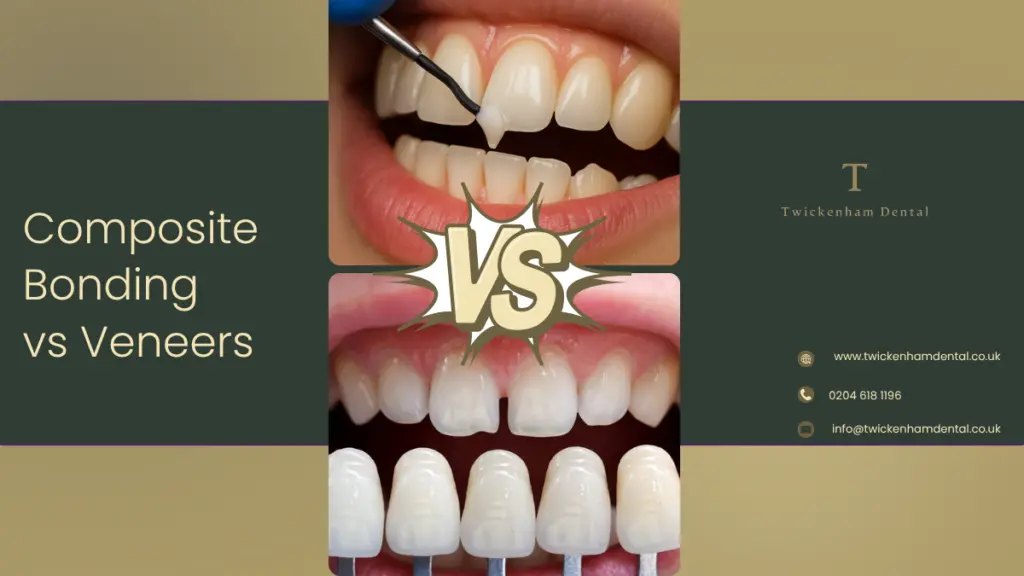
A confident, natural-looking smile can transform not just your appearance, but also your self-esteem. If you’re considering cosmetic dental treatment in Twickenham, you’ve likely come across two popular options: composite bonding and veneers. But which one is right for you?
At Twickenham Dental, we regularly treat patients from Twickenham, Richmond, Teddington, Hounslow, Whitton, and St Margarets who want to improve chipped, discoloured, or uneven teeth. In this guide, we’ll break down the differences between composite bonding and veneers—covering cost, durability, results, and suitability so you can make an informed decision.
What Is Composite Bonding?
Composite bonding (also known as edge bonding or tooth bonding) is a cosmetic dental procedure where a tooth-coloured resin material is carefully applied, sculpted, and polished directly onto your teeth.
This treatment is ideal for:
- Repairing chipped or cracked teeth
- Closing small gaps between teeth
- Improving tooth shape and symmetry
- Enhancing mildly discoloured teeth
In our clinical experience, composite bonding is one of the most popular minimally invasive smile enhancement treatments because it requires little to no removal of natural enamel.
What Are Veneers?
Veneers are thin, custom-made shells placed over the front surface of your teeth to improve their appearance. There are two main types:
- Porcelain veneers (long-lasting and highly aesthetic)
- Composite veneers (more affordable but slightly less durable)
At Twickenham Dental, we commonly recommend porcelain veneers for patients seeking a complete smile transformation or “smile makeover.”
Veneers are ideal for:
- Severely stained or discoloured teeth
- Worn, uneven, or misaligned teeth
- Gaps and irregular spacing
- Full smile redesign
Common Smile Problems These Treatments Solve
Patients often come to us with concerns like:
- “My teeth look uneven in photos”
- “I have small gaps between my front teeth”
- “My teeth are stained and whitening isn’t enough”
- “I chipped my tooth and want a quick fix”
- “I want a more symmetrical, Hollywood-style smile”
Both composite bonding and veneers can address these issues—but the best choice depends on your goals, budget, and long-term expectations.
Composite Bonding vs Veneers: Key Differences
1. Appearance & Results
- Composite Bonding:
Provides natural-looking results, especially for minor corrections. However, it may not achieve the same level of translucency as porcelain. - Veneers:
Offer superior aesthetics with a highly polished, stain-resistant surface. Ideal for dramatic smile transformations.
👉 If your goal is a perfectly aligned, bright smile, veneers may be the better option.
2. Durability & Lifespan
- Composite Bonding:
Typically lasts 3–7 years with proper care - Porcelain Veneers:
Can last 10–15+ years
In our experience, patients who want a long-term solution often prefer veneers due to their durability and resistance to staining.
3. Tooth Preparation
- Composite Bonding:
Minimal or no enamel removal - Veneers:
Requires slight enamel reduction for proper fit
This makes bonding a reversible and conservative treatment, while veneers are more permanent.
4. Treatment Time
- Composite Bonding:
Usually completed in one visit - Veneers:
Typically requires 2–3 appointments
If you need a quick smile fix before an event, bonding is often the preferred choice.
5. Cost in Twickenham
At Twickenham Dental:
- Composite Veneers: From £385 per tooth
- Edge Bonding: From £200 per tooth
- Porcelain Veneers: From £695 per tooth
Composite bonding is more affordable upfront, while veneers offer better long-term value due to their longevity.We also offer 0% APR finance through Tabeo, making it easier to spread the cost of your treatment.
Procedure: What to Expect
Composite Bonding Process
- Consultation and smile assessment
- Shade matching to your natural teeth
- Application of composite resin
- Sculpting and polishing for a natural finish
No anaesthesia is usually required, and the procedure is painless and quick.
Veneers Procedure
- Detailed consultation and smile design
- Tooth preparation (minimal enamel removal)
- Impressions or digital scans
- Temporary veneers (if needed)
- Final placement and bonding
This process ensures precision, durability, and a tailored aesthetic result.
Who Is Suitable for Each Treatment?
Choose Composite Bonding if:
- You have minor chips or gaps
- You want a cost-effective solution
- You prefer a reversible treatment
- You need quick results
Choose Veneers if:
- You want a full smile makeover
- You have severe discolouration or worn teeth
- You’re looking for long-lasting results
- You want a uniform, flawless smile
At Twickenham Dental, we always provide a comprehensive examination and personalised treatment plan to help you choose the best option.
Risks & Considerations
To ensure transparency:
Composite Bonding:
- Can stain over time (especially with coffee, tea, smoking)
- Less durable than veneers
- May require maintenance or touch-ups
Veneers:
- Irreversible due to enamel removal
- Higher initial cost
- Requires good oral hygiene to maintain gum health
Our team will guide you through all risks and benefits during your consultation.
Maintenance & Aftercare
To keep your smile looking its best:
- Brush twice daily with fluoride toothpaste
- Floss regularly to maintain gum health
- Avoid biting hard objects (ice, pens)
- Limit staining foods and drinks
- Attend regular dental check-ups
You can also join our Patient Plan starting from £24.95/month, which includes check-ups, hygiene visits, and discounts on treatments.
Why Choose Twickenham Dental?
We commonly see patients from Twickenham, Richmond, Teddington, Hounslow, Whitton, and St Margarets who want natural, long-lasting smile improvements.
Here’s why patients trust us:
- Experienced cosmetic dentists
- Personalised smile design approach
- Transparent pricing and treatment plans
- Modern technology and techniques
- Flexible payment options with 0% APR finance
📍 Visit us at:
11 York Street, Twickenham, TW1 3JZ
FAQs
No, it’s a minimally invasive procedure and usually requires no anaesthesia.
Veneers require slight enamel removal, but when done professionally, they are safe and long-lasting.
Both can look natural, but porcelain veneers offer superior aesthetics and stain resistance.
Typically 3–7 years, depending on oral hygiene and lifestyle habits.
If you want a long-term, high-quality smile transformation, veneers are often worth the investment.
Final Thoughts
Both composite bonding and veneers are excellent cosmetic dental solutions—but the right choice depends on your individual needs.If you’re looking for a quick, affordable fix, composite bonding may be ideal. If you want a long-lasting, flawless smile makeover, veneers are the better option.
Ready to transform your smile?
At Twickenham Dental, we offer personalised consultations to help you choose the best treatment for your goals and budget.
Take the first step toward a confident, radiant smile.
We offer 0% APR dental finance options with Tabeo, helping you achieve your perfect smile without financial pressure.